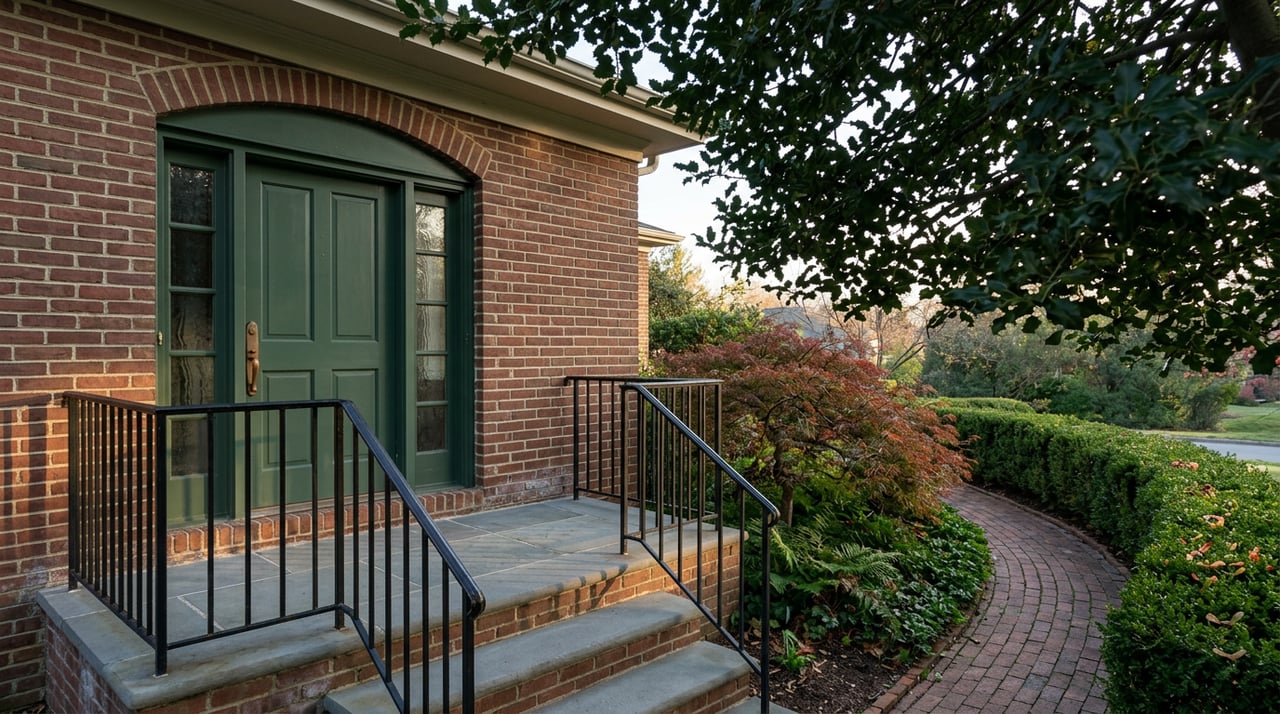
Two buyers can be shopping in Arlington the same week, with the same budget, and end up in almost opposite negotiations.
One is touring a detached house in Cherrydale, competing against other offers on a street where inventory barely moves. The other is touring a one-bedroom in a Clarendon high-rise, where the seller has had the unit listed for months and just cut the price. Both are technically buying in "the Arlington market." Neither is experiencing the same market.
That split shows up the moment either buyer gets serious. The Cherrydale buyer writes an offer, gets an inspection, and closes. The condo buyer has to wait on something the house buyer never touches: a resale certificate. Under Virginia's Resale Disclosure Act, a condo seller has to request this document from the building's association and hand it over before closing. It runs through 30 required disclosures, from unpaid assessments to whether the association has any pending legal issues, and state law caps the preparation fee at $176.64 as of mid-2026, according to CommunityPay's Virginia directory. The association has 14 days to deliver it. If a buyer receives the certificate and doesn't like what's in it, they can cancel the contract within three days of ratification, or up to seven if the contract extends that window, according to Prince William County Neighborhood Services.
Most homes in that pocket of North Arlington are detached houses.
That single piece of paperwork is a small window into something bigger happening across the county: Arlington's single-family and condo markets are no longer telling the same story, and the countywide average price is quietly blending two very different pictures into one number.
The number everyone's repeating, and what it's actually made of
Arlington crossed a threshold this spring that's been showing up in local coverage: the average sale price across all transactions hit $1,004,052 in March 2026, the first time the monthly average topped $1 million, according to Bright MLS data reported by PCRE Homes. April pushed further, with the average climbing to $1,061,497 across 224 recorded sales.
That headline is accurate. It's also an average, and averages hide what's happening underneath them.
Run the numbers by segment and the picture splits in two. The Northern Virginia Association of Realtors and George Mason University's Center for Regional Analysis released a 2026 forecast late last year projecting single-family home prices in Arlington to rise 3.8% year over year, second only to Alexandria's projected 4.2% among Northern Virginia jurisdictions. Condos, in the same forecast, are expected to rise just 2.1%, and that's the recovery number. The year before it, in 2025, condo prices in Arlington actually fell by roughly 7.4%, making condos the weakest-performing segment in the county that year.
Inventory tells the same story from a different angle. The 2026 forecast projects condo inventory growing 30.9%, well ahead of the 27.8% projected for single-family homes and 20.8% for townhomes. More condos are coming onto the market at the same time fewer of them are selling for what sellers hoped, which is a straightforward supply and demand mismatch rather than a sign buyers have soured on condo living generally.
| Segment | 2025 price change | 2026 projected change | 2026 projected inventory growth |
|---|---|---|---|
| Single-family detached | up modestly | +3.8% | +27.8% |
| Townhomes | roughly flat | +1.9% | +20.8% |
| Condominiums | about -7.4% | +2.1% | +30.9% |
Source: NVAR and George Mason Center for Regional Analysis 2026 forecast, reported by ARLnow, January 2026.
Why the split is happening, not just that it is
Land is the simple half of the explanation. North Arlington neighborhoods like Cherrydale, Lyon Village, Bellevue Forest, Country Club Hills, and the Dominion Hills corridor were among the strongest price performers heading into 2026, and none of them can add meaningful new single-family inventory. There's no vacant land left to build detached houses on in a neighborhood platted a century ago. Every buyer competing for one of those houses is competing for a supply that structurally cannot expand, which is exactly the kind of scarcity that keeps pushing prices upward even as the broader market cools.
Condos run on a different mechanism entirely. New construction and resale inventory can both expand in a way single-family supply can't, and in Arlington's Clarendon, Ballston, Courthouse, and Virginia Square corridor, it has. At the same time, the carrying cost of owning a condo has been climbing. Part of what's holding back condo prices, per the same NVAR forecast, is that condo association fees have been rising to reflect three years of general inflation. A buyer isn't just weighing the sale price anymore. They're weighing a monthly number that's grown, on top of a purchase price that hasn't kept pace with houses.
You can see this play out unit by unit. At Ballston 880 Condominium, a 123-unit building completed in 2000, one-bedrooms between 615 and 880 square feet have priced between $440,000 and $489,900. At Clarendon 1021, a 419-unit building completed in 2005 five minutes from the Clarendon Metro stop, one-bedrooms between 600 and 957 square feet have priced between $415,000 and $680,000. Those are wide ranges within buildings that are, on paper, similar products in similar locations. The gap usually comes down to what's inside that resale certificate: how healthy the reserve fund is, whether a special assessment is coming, how the monthly fee compares to a building down the street.
That's the detail a Cherrydale buyer never has to price in. A house's carrying cost is mostly the mortgage and the tax bill. A condo's carrying cost includes a fee that can move, and a resale certificate that tells you which direction it's likely to move before you sign anything.
What this means if you're comparing the two
A buyer choosing between a starter house in North Arlington and a condo in the Clarendon-Ballston corridor isn't really choosing a neighborhood. They're choosing which side of a diverging market they want exposure to.
On the house side, that means accepting a market where thin inventory keeps pricing power with the seller, where a well-prepared offer still needs to move fast, and where the premium buyers are paying for scarcity is not likely to loosen soon given how little land is left to build on in those pockets.
On the condo side, it means more room to negotiate on price, but it also means the real due diligence isn't the listing sheet. It's the resale certificate, the reserve study attached to it, and the board minutes from the last twelve months. The Virginia Department of Professional and Occupational Regulation says that, since 2023, Virginia's standardized resale certificate form has required fees to be paid when the certificate is ordered rather than rolled into settlement costs, a change that still catches some buyers and sellers off guard when they assume it works the old way. A building with a healthy reserve and no pending special assessment is a very different bet than one that looks similar from the street but is quietly underfunded.
Neither path is the wrong one. They're just different transactions wearing the same countywide price headline.
Common questions
Does every condo purchase in Arlington require a resale certificate? Yes. Any resale of a unit inside a common interest community in Virginia requires the seller to obtain a resale certificate from the association and deliver it to the buyer, under the state's Resale Disclosure Act.
If condo prices fell in 2025, why are condo fees going up? The two are moving independently. Association fees are largely a function of building operating costs and reserve funding, which have climbed with several years of general inflation, regardless of what unit prices are doing on the resale market.
Are single-family homes in North Arlington always exempt from a resale certificate? Always confirm whether a specific property carries any recorded association obligations before assuming that's the case.
If you're trying to figure out which side of this split actually fits your budget and your timeline, that's exactly the kind of neighborhood-by-neighborhood read Bediz Group works through with buyers every day across the DC area. Book an appointment and we'll walk through what a specific building's resale certificate or a specific block's recent closings actually tell you, before you write an offer instead of after.
This article is general information, not legal, tax or financial advice. Consult a qualified professional about your situation.